 Home
Home- Velocity/Engine Speed Programme
- Example
- Puch Maxi E50 - std cylinder and carb
- Puch Maxi E50 - Fuel Consumption v Throttle Position
- Puch Maxi E50 - Fuel Consumption v Cylinder Head Design
- Puch Maxi E50 - Engine Details
Velocity/Engine Speed Programme - Puch Maxi
The Velocity programme allows the user to either calculate the velocity at a given engine speed or calculate the engine speed for a given velocity for a Puch Maxi E50.
Top
Example
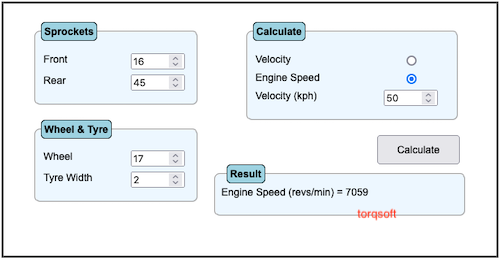
Suppose you have a Puch Maxi E50 in original condition. Your top speed on the flat is 50 km/hr on 16/45 gearing and the tyres are 2" wide. Simply enter this information into the program and select the engine speed radio button. Now enter 50 into the velocity box and hit the Calculate button. The calculated engine speed is 7,059 revs/min.
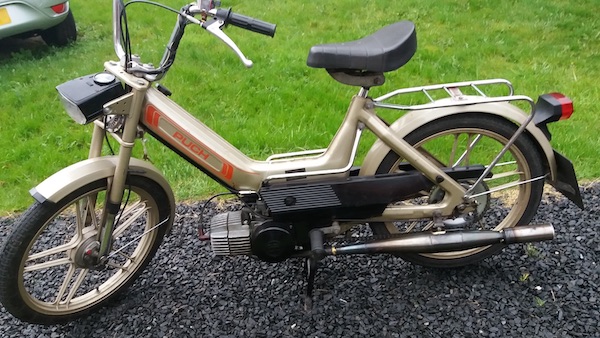
Puch Maxi E50 - mid 80's model
Shown below is a mid 80's Puch Maxi E50. This particular bike is 100 % original bar the fitment of a Torqsoft design exhaust system.
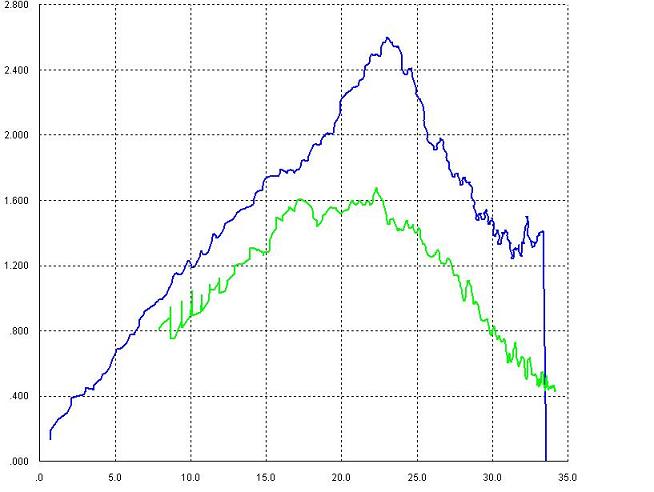
The design brief for this pipe was to obtain the same top speed as the std pipe - 50 km/hr - but to have better hill climbing ability, particularly on the steeper hills. The hill climbing velocity for the steep test hill increased from 16 mph(25 km/h) for the std pipe to 22 mph(35 km/h) with the new Torqsoft pipe.
Shown below is the measured power(hp) vs road speed(mph) at the rear wheel for standard pipe vs Torqsoft pipe. The power has increased from 1.65 hp to 2.6 hp, an increase of 62 %. It can also be seen that the acceleration has improved considerably as has the overev power. At 30 mph(48 km/hr) the standard pipe gives 0.8 hp vs 1.45 hp for the Torqsoft pipe.
Puch Maxi E50 - Fuel Consumption v Throttle Position
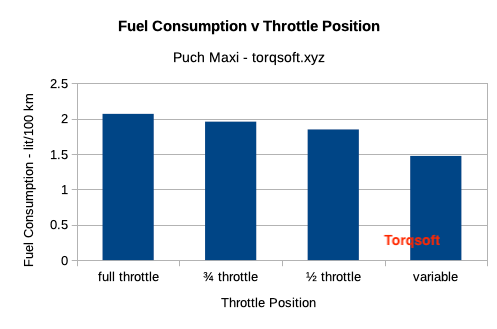
The table below shows the measured fuel consumption - in both mpg (imperial) and l/100km - for a Puch Maxi E50 at different throttle settings. The test course was 30.4 km long over undulating terrain. Fully kitted inc helmet etc, the test rider weighed 77 kg.
The optimum fixed throttle position was found to be 1/2 throttle, resulting in a fuel consumption of 1.85 l/100km (153 mpg imp).
At a later date we carried out extensive variable throttle testing combined with changing the carburettor settings and achieved a best fuel consumption of 1.475 l/100 km (191.5 mpg imp).
| Throttle | Consumption | ||
|---|---|---|---|
| Gearing | MPG | l/100km | |
| full throttle | 16/45 | 136 | 2.07 |
| 3/4 throttle | 16/45 | 144 | 1.96 |
| 1/2 throttle | 16/45 | 153 | 1.85 |
| variable | 17/45 | 191.5 | 1.475 |
Shown below is a Graph of these fuel consumption tests. It is clearly evident that reducing the throttle opening results in improved fuel economy and that a variable throttle strategy actually gives the best fuel economy.
Puch Maxi E50 - Fuel Consumption v Cylinder Head Design
An extensive testing program was then carried out using a total of 6 cylinder head designs. These heads had various squish area/squish clearance plus compression ratio permutations. The best head permutation resulted in a fuel consumption of 1.275 l/100 km (221.5 mpg imp), an improvement of 15.6 % compared to the std head.
Top
Puch Maxi E50 - Engine Details
The table below shows the Port Durations for this totally original engine. The cylinder has open transfers - of which there are two off. It is immediately apparent that the port timings are very mild.
| Port | Duration (deg) | |
|---|---|---|
| Exhaust | 134.6 | |
| Transfer | 90 | |
| Inlet | 120 | |
| Bore | 38.0 | |
|---|---|---|
| Stroke | 43.0 | |
| Comp Ratio | 9.2 | |
Top